

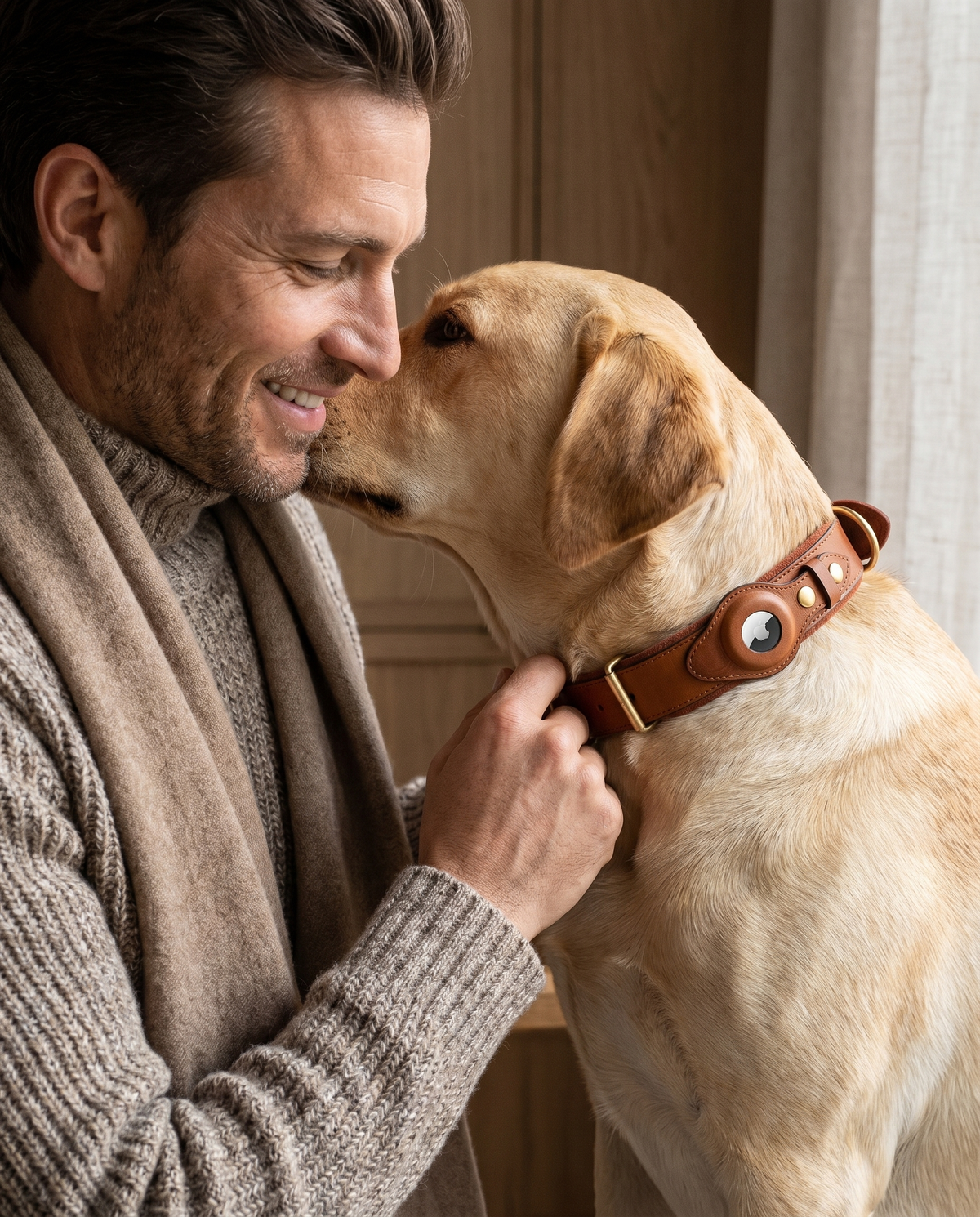
Keeping your dog calm during fireworks doesn't start on New Year's Eve. It starts weeks earlier. On the night itself, all you can really do is muffle the noise, block the view and stay close. The work that actually moves the needle (sound desensitisation, building a safe space and, if needed, a conversation with your vet) takes time. This guide covers what demonstrably helps, what backfires, and how to make sure your dog comes back quickly if he bolts anyway.
Short answer: how do you keep a dog calm during fireworks?
- Weeks ahead: build up sound desensitisation with recordings, set up a fixed hiding spot, and see your vet if the fear is severe.
- The last week of December: keep your dog on a lead at all times, including in the garden, and check your property for gaps and open gates.
- New Year's Eve: walk before dark, close the curtains, leave a light and quiet background sound on, and stay with your dog.
- Comforting is fine: petting a frightened dog does not reinforce the fear.
- In case it goes wrong: a properly fitted collar with your phone number and a tracker you've already tested.
Why fireworks hit dogs so hard
Fear of fireworks isn't disobedience, and it certainly isn't drama. Three things come together that make it almost impossible for a dog to relax.
Dogs hear far more sharply than we do
A dog's hearing range extends well beyond ours. A bang you find loud lands even sharper with him. On top of that, dogs are much better at pinpointing where a sound comes from, so every blast demands his attention.
Unpredictability makes habituation hard
A dog can get used to the bin lorry that comes every Tuesday morning, because it's predictable. Fireworks never are: they arrive at a random moment, from a random direction, without any warning. As a result, his brain can't learn a pattern and every bang stays a surprise.
It's more than just noise
A bang comes with flashes of light, the smell of gunpowder and vibrations in windows and floors. Dogs link those cues together. That's why some dogs later react to thunderstorms or a slamming door too: the association has grown wider than the original sound.
Left alone, the fear usually gets worse each year rather than better. Even a dog who stayed calm last New Year's Eve can react this time.

Spot the stress signals early
Most owners only notice obvious panic: trembling, whining, hiding. The early signals are subtler, and those are exactly the ones that let you step in before your dog goes over his threshold.
Early signals
- panting when it isn't warm and he hasn't been running
- yawning, lip-licking or repeatedly licking his nose
- ears flat, tail low, moving closer to the ground
- restless pacing, or freezing completely still
- staying closer to you than usual
The best thermometer: is he still eating?
If your dog refuses a treat he'd normally take instantly, the tension is too high for training or distraction. From that point on there's no sense in practising, so switch to quiet, muffling and closeness.
Weeks ahead: this is where the results come from
If you want to keep your dog calm during fireworks, the outcome is largely decided in October and November. Three measures do most of the work.
1. Sound desensitisation with a positive association
Firework recordings let you build up your dog's tolerance gradually. The order matters more than the duration. Play the sound so quietly that he barely notices it, and pair it immediately with something pleasant: food, a game or a snuffle mat. Only once he stays completely relaxed do you go one small step louder.
Expect weeks to months, not days. Push too fast and you confirm the fear instead, leaving you worse off than when you started. If you see tension even at the lowest volume, stop and bring in a certified behaviourist. Severe noise phobia isn't something you fix with a speaker.
2. Build the safe space now
A hiding spot only works if your dog already knows it and likes it. A crate that appears in the living room for the first time on 31 December is a cage to him, not a refuge.
Pick a room without windows facing the street, preferably low in the house. Put his bed there, along with a piece of your clothing and something to chew. Feed him there now and then and let him nap there during the day. By late December it should be somewhere he goes on his own. Always leave the door open, because being able to choose is half the battle.
3. Talk to your vet in November
If your dog was genuinely panicking last year, that belongs in a conversation with your vet. There are veterinary medicines licensed specifically for noise phobia in dogs, available on prescription only. What's appropriate depends on age, health and how severe the fear is.
Do it in good time, so not on 30 December. Anything you give for the first time on New Year's Eve can turn out differently than expected. A November appointment leaves room to try it calmly. Also, never give your dog human medication and don't use leftovers from another dog.
4. Get identification in order
This is the step people put off most and the one that pays off most if things do go wrong:
- Microchip and registration: every dog in the Netherlands must be chipped and registered with a portal designated by the RVO. Check that your current address and phone number are still on file.
- Tag or engraved collar: a pet microchip works on a frequency an ordinary phone can't read, so a scanner is needed. A phone number on the collar can be used by any finder straight away.
- Tracker: paired, tested and with a fresh battery.
- Recent photo: sharp, from the side and the front, with colour and markings clearly visible.
Save that photo and the chip number in a note on your phone now. Our guide on finding your dog's chip number and checking the registration has a checklist you can work through in half an hour.
The last week of December
Since 1 August 2026 the Netherlands has a nationwide ban on consumer fireworks. Only light F1 items such as sparklers remain allowed, and municipalities can grant exemptions to clubs and foundations for an organised display.
So there will be fewer bangs, but no guarantee of silence. Illegal fireworks don't disappear because of a ban, and things get set off during the day and in the days beforehand too. Treat the whole final week as a risk period.
- Keep your dog on a lead, even if he's normally reliable off-lead.
- Check your garden for gaps under the fence and lock the gate.
- Agree who answers the front door when guests arrive, and put the dog behind a closed door first.
- Schedule busy errands and vet visits earlier in the month.
New Year's Eve itself: what still helps
Walk before dark
Do the last long walk well before sunset and pick a quiet route. If you have to go out later for a toilet break, keep it short and stay close to home. Use a harness he can't twist out of.
Muffle the sound, block the view
Close windows and curtains and turn the lights on indoors, so the flashes outside stand out less. Then put on quiet music or the television at normal volume, with no bangs in it. The goal isn't to drown out the fireworks but to make the sharp peaks less abrupt.
Comforting really is allowed
The old idea that petting a frightened dog reinforces the fear is no longer followed by vets and behaviourists. If your dog seeks contact, give it: calm stroking, a calm voice, simply sitting next to him. If he'd rather hide behind the sofa or under the bed, leave him there and don't pull him out.
Behave as normally as you can yourself. Dogs read your tension perfectly, so visibly anxious behaviour confirms to him that something really is wrong.
Don't leave him alone
New Year's Eve is not the night to leave your dog home alone, however well he normally copes. A panicking dog on his own can injure himself on doors and frames, or escape. If it truly can't be avoided, arrange someone he trusts. For building up alone time during the rest of the year, see leaving your dog home alone.
What doesn't work
- Punishing or correcting. Barking, whining and pacing are fear responses, not disobedience. Correcting increases the fear and damages the trust you need that night.
- Exposing him so he gets used to it. Taking your dog outside to show him it's not that bad does exactly the opposite. Habituation only works in small, controlled steps.
- Shutting him in an unfamiliar room. A panicking dog who can't get away can injure himself on doors, frames or bars.
- Choosing medication yourself. Human sedatives aren't simply suitable for dogs. Some products also only suppress the visible reaction while the fear remains, which is the worst of both worlds.
- Leaving everything until 31 December. The measures with the most effect simply need weeks.
Aids: what can you expect from them?
There's plenty on the market: pressure vests, pheromone diffusers, calming supplements and specially composed music. Some owners see a clear effect, with other dogs little happens. The research behind these products is generally a lot thinner than the evidence for desensitisation and for prescription medication.
That doesn't mean you should skip them. Just treat them as an addition rather than a solution. If you want to try one, do so a few times well in advance, so it isn't new on the night itself.
If your dog panics and bolts anyway
Most dogs that go missing around New Year don't escape from a closed house. They startle during a walk, or slip through a door that's briefly open for the neighbours. Two things then determine how quickly your dog comes back.
A collar that fits and doesn't come off
A dog backing up and twisting out of his collar is a New Year's Eve classic. So check the fit: exactly two fingers should lie flat between the collar and his neck. If you're unsure about the size, measure his neck with a tailor's tape and use our collar sizing guide by breed. Torn between a collar and a harness? Read collar or harness for your dog.
A tracker that's already paired and tested
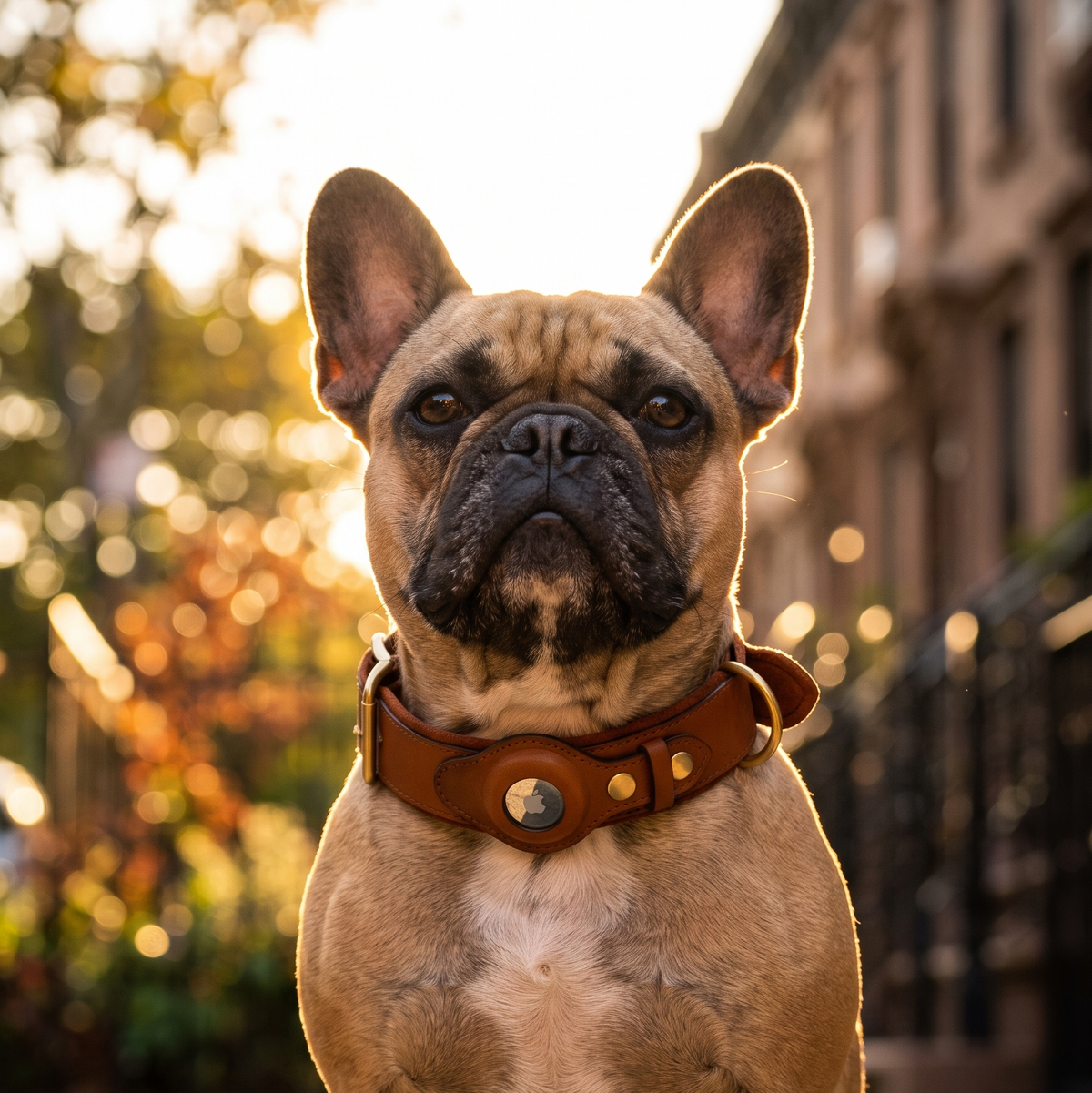
The Le Classique Set: leather dog collar with a hidden AirTag compartment plus matching lead is built for exactly this scenario. Your dog startles at a bang, gets loose in your own neighbourhood, and you want to know which way to go within a minute. The AirTag sits in a compartment on the inside of the leather, so nothing dangles, breaks off or snags.
It works through the Find My network: the AirTag emits a Bluetooth signal picked up by nearby Apple devices, which pass the location on in encrypted form. On New Year's Eve, with plenty of people outdoors in a residential area, that network is at its densest. For escapes in built-up areas it usually produces a usable position quickly.
If you live rurally and want to watch live while your dog moves, read our comparison of an AirTag and a GPS tracker. Don't own an iPhone yourself? There's a workaround via an Apple Account, described in does an AirTag work with Android.
The set costs €79.95 and comes in brown and black, in sizes S (28-38 cm), M (36-48 cm) and L (46-60 cm). Order in good time: a collar arriving on 30 December still needs pairing, and you'll want to check the fit calmly.

The first minutes after he goes missing
Stay where your dog disappeared first, because many dogs return to that spot after a while. Call calmly and in a low voice: running and shouting drives a frightened dog further away. Ask someone to stay at home as well, since dogs often turn up at the front door on their own.
Then put your tracker into lost mode, report the disappearance to the portal where the chip number is registered, and report your dog to Amivedi, the Dutch national register for missing and found pets. Also call the animal ambulance, the local shelter and the police. The full step-by-step plan is in dog missing at New Year and in the plan for the first hour.
Checklist: a calm dog through New Year
- October: start sound desensitisation and set up the safe space.
- November: book a vet appointment if needed, and check chip registration, tag and collar size.
- Mid-December: pair and test the tracker, and take a recent photo of your dog.
- Final week: always walk on a lead, check the garden and gate.
- 31 December: walk before dark, curtains closed, light and sound on, collar on, and stay home yourself.

Frequently asked questions about dogs and fireworks
How do I keep my dog calm during fireworks?
Start weeks ahead with sound desensitisation and a fixed hiding spot. On New Year's Eve, walk before dark, close the curtains, leave a light and quiet background sound on, and stay with your dog. If the fear is severe, discuss prescription medication with your vet in advance.
Can I comfort my frightened dog during fireworks?
Yes. The idea that this reinforces the fear is outdated. If your dog seeks contact, give it calmly. If he'd rather hide, leave him alone and don't pull him out of his hiding place.
How far in advance should I start sound desensitisation?
Expect weeks to months, depending on how severe the fear is. Start in October or November at the latest. Building up too fast makes the fear worse, so there's no point rushing.
Do pressure vests or pheromone diffusers help with firework phobia?
They help some dogs and not others, and the evidence is thinner than for desensitisation or prescription medication. Treat them as an addition and try them a few times well in advance, so they aren't new on the night.
Can I give my dog a sedative myself?
No, that's a question for your vet. There are veterinary medicines licensed for noise phobia in dogs, available on prescription only. Book an appointment in November so there's time to try something. Never give human medication.
Can I let my dog off the lead around New Year?
Better not. Even a dog who's normally reliable can bolt in blind panic at an unexpected bang. Keep him on a lead throughout the last week of December, including in the garden and during the day.
How tight should a dog collar be?
Two fingers should lie flat between the collar and your dog's neck. Any looser and a dog backing away can work his way out, which is exactly what happens in a panic. Any tighter and it pinches.

Leave a comment
This site is protected by hCaptcha and the hCaptcha Privacy Policy and Terms of Service apply.