

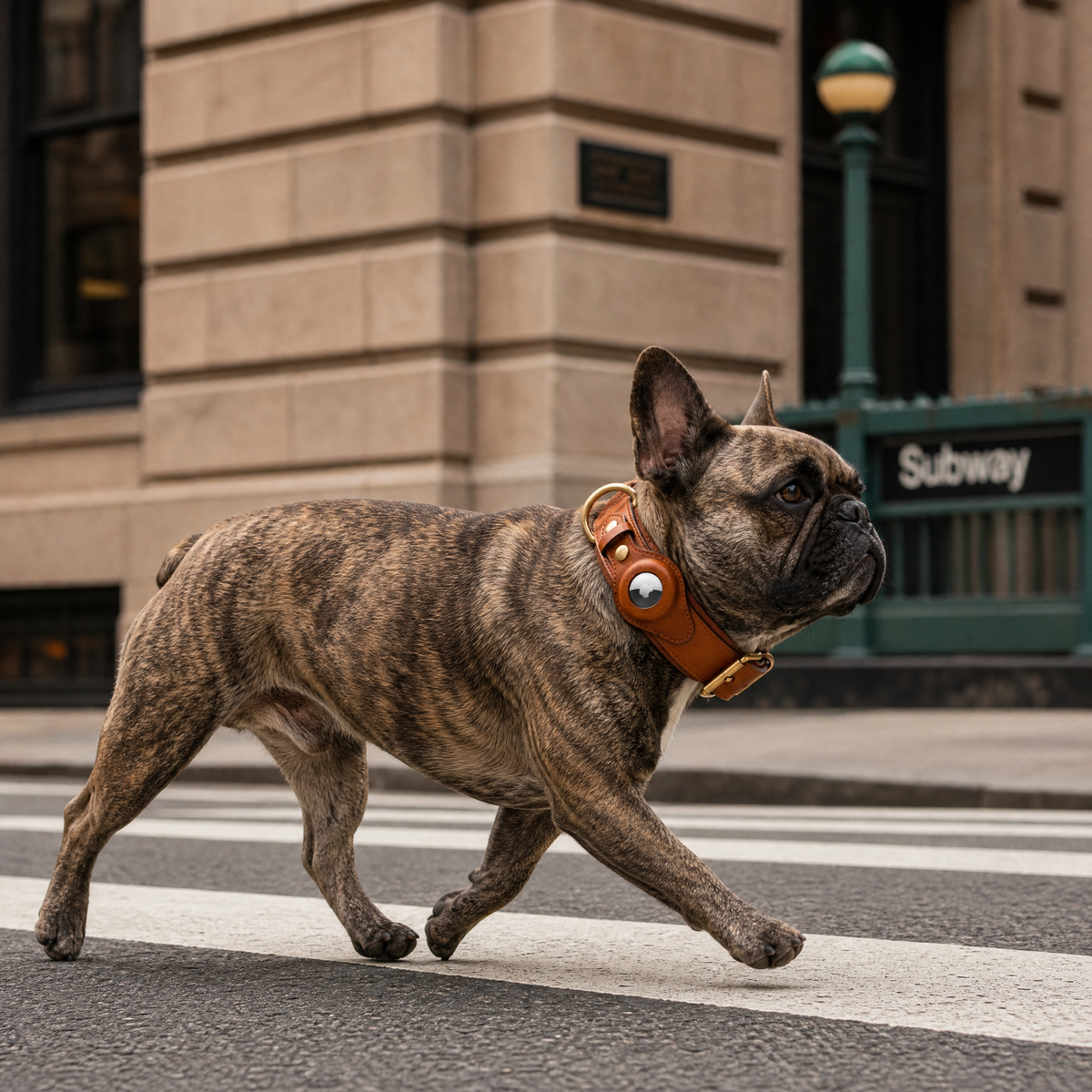
The first collar I bought for my dog lasted three months. It looked great in the store: dark brown, shiny, with a sturdy buckle. After one wet autumn, the edges frayed, the leather bled onto his fur, and the buckle squeaked with every step. Only then did I realize that a luxury leather dog collar isn't about how something looks in a picture, but about how it holds up after two hundred rainy walks.
Because that's precisely what it's all about. Your dog wears his collar more often than you wear any piece of clothing. He sleeps in it, rolls in the grass with it, swims with it, and tugs at it whenever a squirrel crosses his path. A luxury leather dog collar must be able to withstand all of that and still look better after two years than it did on day one. In this article, you'll learn exactly where that difference comes from, how to spot quality yourself in thirty seconds, and what mistakes most buyers make.
The short answer
A good luxury leather dog collar is made from full-grain or top-grain leather at least 3mm thick, has solid brass or stainless steel hardware, a soft lining on the inside, and double stitching with nylon or polyester thread. The width should suit your dog's size: 1.5 to 2 cm for small breeds, 2.5 to 3 cm for medium breeds, and 3.5 to 4 cm for large dogs. Expect a lifespan of five to ten years with normal maintenance.
What makes a luxury leather dog collar truly luxurious?
The word "luxury" appears on almost every product page nowadays. Yet, there's a measurable difference between a fifteen-euro collar and an eighty-euro collar, and that difference lies in five key areas.
First, the leather itself. Cheap collars are often made of a thin layer of leather dust mixed with glue and pressed into a sheet. This is called bonded leather, and it behaves like cardboard: it doesn't bend, it tears along the fold line, and it falls apart as soon as it gets truly wet.
Second, the hardware. Galvanized zinc is dirt cheap and breaks without warning. Solid brass, on the other hand, will bend before it snaps, making it safer when your dog suddenly lunges.
Third, the edge finishing. A craftsman will burn or polish the cut edges and treat them with an edge sealant. Without this step, the leather will start to fray within a few months, precisely where the fur rubs against it.
Fourth, the construction. In a truly luxurious leather dog collar, the D-ring is secured between two layers of leather, riveted with solid rivets. In cheaper versions, this same ring hangs from a single seam, and that's precisely where one hundred percent of the pulling force is applied.
And finally, the inside. Turn a collar over. Does the back feel rough, sticky, or plastic-like? Then that's what's against your dog's skin all day.
Which leather is best for a leather dog collar?
Not all types of leather are created equal. In fact, the differences are so vast that two products with the same "genuine leather" label can have a ten-year difference in lifespan.
| Leather Type | Lifespan | Suitable for collar? |
|---|---|---|
| Full-grain | 8 to 15 years | Yes, the best choice |
| Top-grain | 5 to 10 years | Yes, excellent alternative |
| Split / suede | 1 to 3 years | Only as lining |
| Bonded leather | 6 to 18 months | No |
| Faux leather (PU) | 1 to 2 years | No |
Full-grain leather
Here, the top layer of the hide remains fully intact, including its natural grain. This layer has the strongest fiber structure that exists, and it's precisely this that is sanded away in cheaper leather. An added benefit: full-grain develops a patina. After a year of wear, the leather acquires a deeper sheen and a color gradation unique to your dog.
Top-grain leather
The top is lightly sanded to remove imperfections, after which a thin finish is applied. The result looks more uniform and is slightly more supple, but you sacrifice some tear resistance. For most dogs, this remains more than sufficient.
Split leather and bonded leather
Both come from the lower layers of the hide or even from scrap material. They feel surprisingly soft in the store, and that's precisely the pitfall. As soon as tension is applied, they stretch and permanently lose their shape.
How to recognize real leather in thirty seconds?
You don't have to be a leather craftsman to assess quality. You can do these five checks right in the store or as soon as your package arrives.
- Smell it. Real leather smells earthy and warm. Faux leather smells chemical or of nothing.
- Look at the cut edge. With real leather, you'll see a fibrous structure. With faux leather, you'll see a clean, even line, sometimes with a fabric-like backing.
- Bend it in half. Real leather will develop fine wrinkles and spring back. Faux leather will crease sharply, and the crease will remain visible.
- Feel the temperature. Leather will absorb your body heat within seconds, while faux leather will remain cool and clammy.
- Press with your thumb. With full-grain, the pressure will spread in a natural pattern of small wrinkles around your finger.
Still in doubt? Simply ask the salesperson for the leather type and thickness in millimeters. Anyone who makes a luxury leather dog collar knows that answer by heart.
The hardware: this is where things usually go wrong
Research among dog owners consistently shows the same thing: if a collar fails, it's almost never the leather but the metal components. That's why this is the part you should scrimp on the least.
The D-ring
Your dog literally hangs from this ring. Therefore, choose a welded, solid ring made of brass or stainless steel. You can recognize an unwelded ring by the gap in the curve, and it's precisely there that it will bend open under a strong tug. Also, check that the ring is secured between two layers of leather and not just to a loop with stitching.
The buckle
A classic buckle distributes the force across the entire leather and has no fragile mechanism. A quick-release buckle is faster to use, but the plastic versions become brittle in freezing temperatures. For a luxury leather dog collar, the classic buckle is still the standard, also because it allows for more precise fit adjustment.
Rivets and stitching
Solid rivets are stronger than any seam. Combined with double stitching of polyester or nylon thread, you get a connection that can effortlessly withstand the pulling force of an adult Labrador. Cotton thread, on the other hand, rots away when it gets wet regularly.
Lining and width: invisible comfort
A collar made of hard, untreated leather chafes. For short-haired breeds like the French Bulldog, Boxer, or Whippet, you'll see it as a bald streak in their fur within a few weeks. A lining of microfiber or soft suede absorbs this friction, which makes a huge difference in practice.
Width plays an equally important role. The wider the collar, the better the pressure is distributed across the neck. However, wider isn't automatically better: for a small dog, a wide collar will press against the jaw when they look up.
- Small breeds (up to 10 kg): 1.5 to 2 cm wide
- Medium breeds (10 to 25 kg): 2.5 to 3 cm wide
- Large breeds (from 25 kg): 3.5 to 4 cm wide
How to choose the right size?
By far, most complaints about collars are not about quality, but about fit. Too tight restricts breathing, while too loose allows your dog to slip out of the collar backwards — precisely when he gets scared.
Here's how to measure in four steps:
- Grab a measuring tape or a piece of string and a ruler.
- Loosely wrap it around the neck, about two fingers below the ears, which is where the collar will sit.
- Note the circumference in centimeters.
- Add two fingers' width, which amounts to about 2 to 3 cm.
Guideline per size at Fidele:
| Size | Neck Circumference | Example Breeds |
|---|