


At Fidele we ran into this problem ourselves: attaching an AirTag to our dog's collar without it rattling, falling off, or getting in the way. That's why we developed the Fidele leather dog collar with hidden AirTag pocket, where the AirTag is included as standard instead of a separate part you have to figure out yourself. Still deciding between a leather collar and other materials? Also read our buying guide to the best luxury leather dog collar.
There are roughly four ways to attach an AirTag to your dog's collar: a silicone case on the D-ring, a DIY solution with tape or a pouch, a separate holder that slides over the band, and a collar with a built-in pocket like the Fidele collar. Below we compare them honestly on four points you'll notice in daily use: how much noise it makes, how quickly you lose the tracker, how well it holds up to chewing, and how easy it is to get to the battery.
The short answer: a collar with a built-in pocket, like the Fidele collar, scores best on all four points, because nothing hangs loose from the band. A separate holder around the band is a good middle ground if you want to keep your current collar. A silicone case on the ring is the cheapest entry point, but it dangles and can come off a weak ring. Making something yourself with tape is the least reliable route. Below you'll find exactly why, per option, and at the very bottom how to order the Fidele collar.
What attachment really comes down to
Almost all complaints about AirTags on collars come down to four things. Walk through these four with your dog in mind, and you'll choose the right option within two minutes.
- Rattling. An AirTag in a hard case on the same ring as the ID tag taps against that metal with every step. Some owners don't notice, others go crazy hearing it on the couch in the evening.
- Losing it. A case on a cheap carabiner or split ring can pop open when your dog dives through bushes. The annoying part is you only notice the moment you actually need the tracker.
- Chewing. A dog can't easily reach its own collar with its mouth, but another dog can. During rough play, dogs nip at the neck, and a protruding case is an easy target. As with any coin battery, swallowing it can cause serious internal damage. You don't want a torn-off AirTag in a dog's mouth.
- Getting to the battery. The battery lasts multiple years, but it does eventually run out. If you have to pick at tape or force stitching to replace it, you'll put it off and walk around with a dead tracker for months.
Option 1: a silicone case on the ring
This is the simplest and cheapest of the four routes. You buy a case the AirTag clicks into, hang it on the D-ring, and you're done. For a dog that's mostly on a leash and calm at home, this is a workable entry point.
The downsides are predictable. The case dangles, so it taps against the ID tag and buckle. On cheap versions, the snap edge gets looser after a few times opening it. Since everything hangs off one ring, a broken split ring means you lose both your ID tag and tracker at once. So choose a case that closes completely and use a closed ring instead of the included hook.
Option 2: DIY with tape or a pouch
This is often used as a quick fix: taping an AirTag to the inside of the band, stuffing it in an old key case, or sewing it into a homemade pouch. It costs nothing and you can sort it out tonight. If you're travelling tomorrow, it's a fine stopgap.
As a permanent solution, it's the weakest of the four. Tape comes loose once the band gets wet or dirty, and a homemade pouch is only as strong as the stitching. You only find that out when it fails. On top of that, a hard object often ends up pressing against the neck, which can cause a pressure spot. If you do it anyway: check every walk that it's still in place.
Option 3: a separate AirTag holder on the band
A step up is a holder you thread through the collar or clip around it, so the AirTag lies flat against the band. Nothing dangles, so it doesn't rattle and there's less to snag on. A good middle-ground solution if you want to keep your current collar.
Do pay attention to fit. These holders are made per band width: on a narrower band, a too-loose holder will still slide back and forth. So measure your band's width first and compare it to the holder's size. Also note: the tighter the holder fits, the more fiddly a battery swap becomes.
Option 4: a collar with a built-in pocket (the Fidele solution)

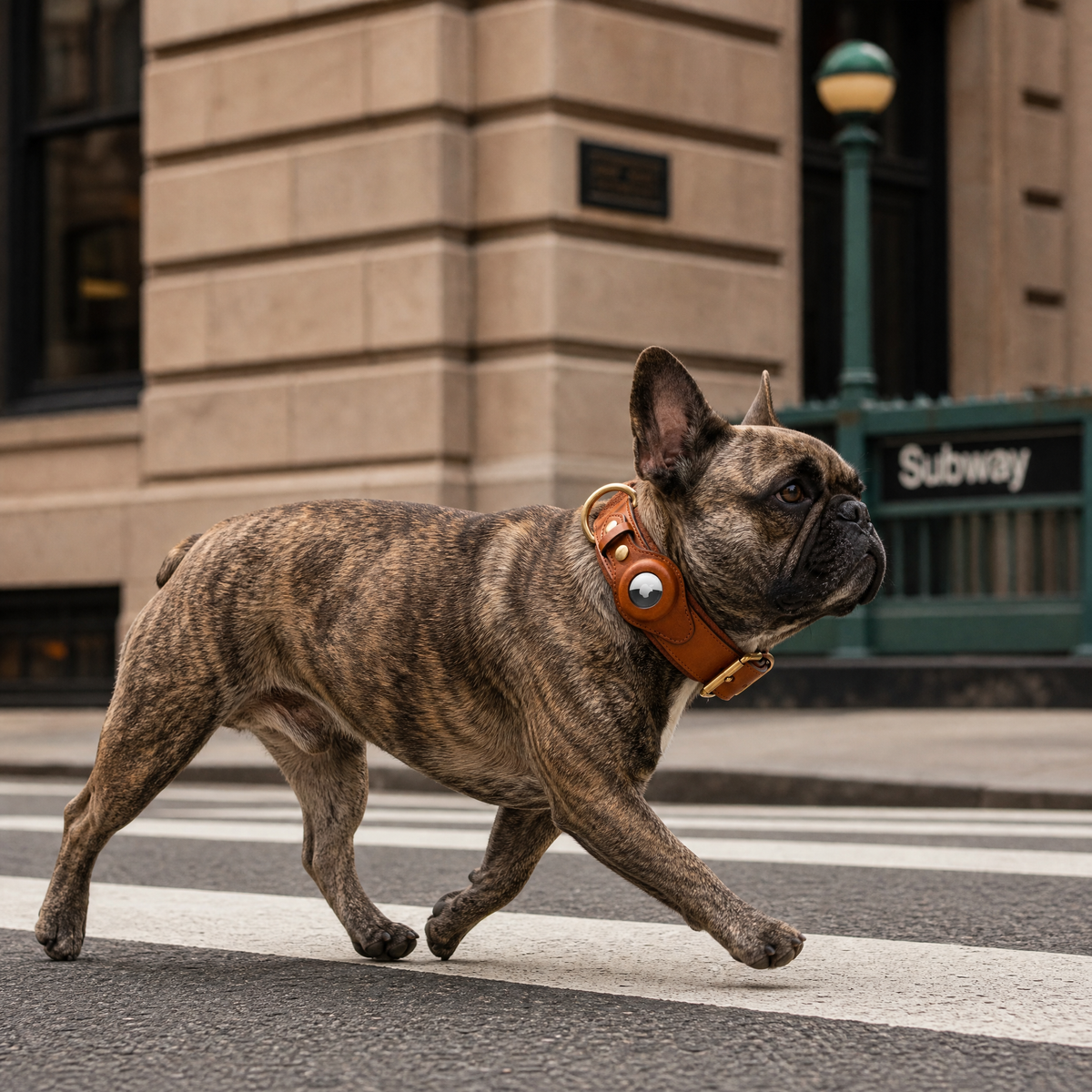
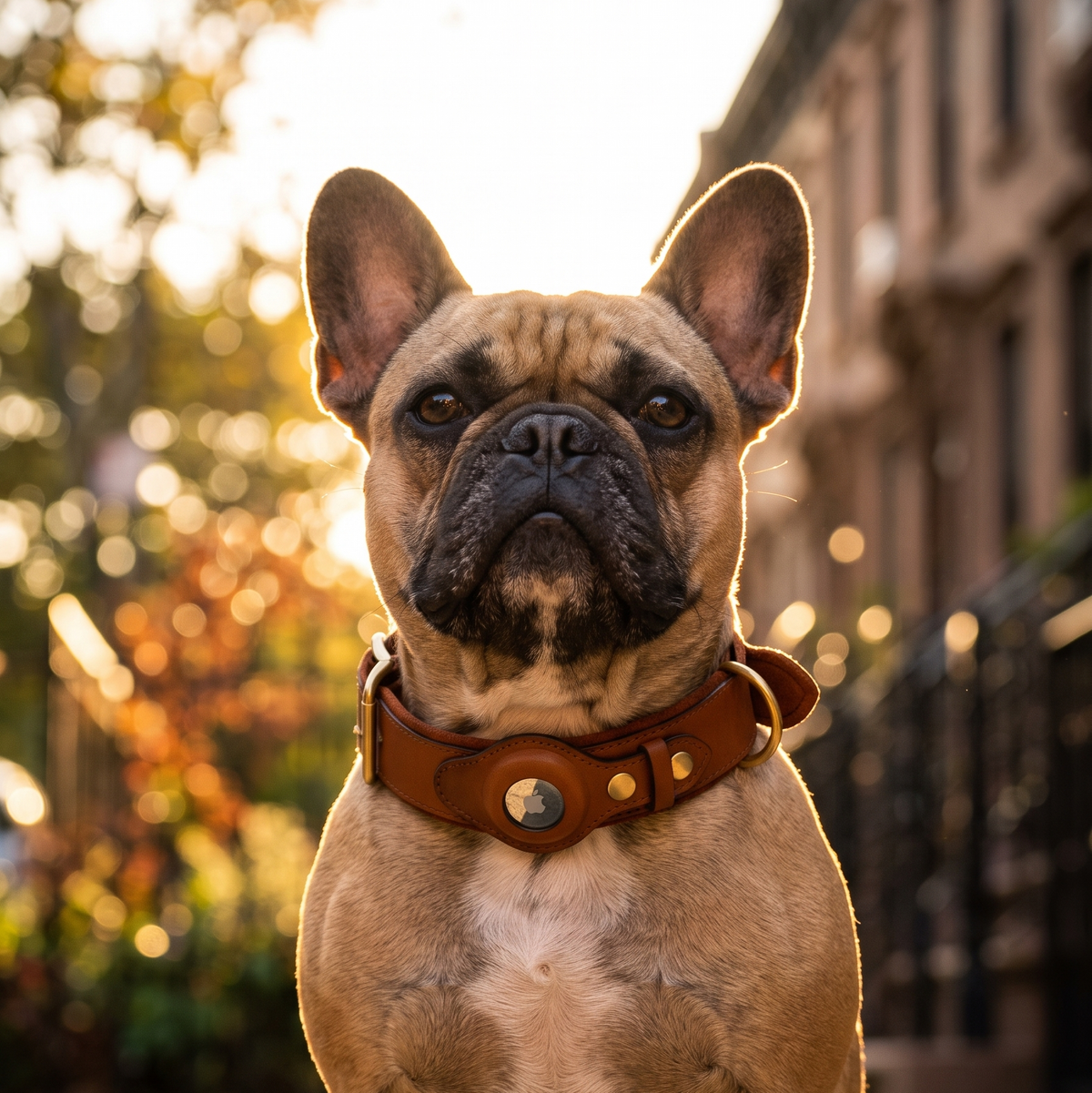
Here the pocket is already built into the band. The AirTag lies flat in the band, out of sight and out of reach of other dogs' teeth. Nothing hangs, so nothing rattles and nothing can come off a ring. On all four criteria above, this is the strongest setup, and it's also the only one where the tracker is part of the collar instead of an add-on to it.
That's the idea behind our leather dog collar with hidden AirTag pocket, where the AirTag is included as standard with every variant. So you're not buying a collar and then a separate tracker and holder: it's all included. S (28-38 cm) costs €69.95, M (36-48 cm) €79.95, and L (46-60 cm) €89.95, in brown and black. The bundle with a matching leash costs €30 more, so €99.95, €109.95, or €119.95.
Do the math and the difference with a separate route isn't huge: an AirTag alone already costs around €35, plus a collar and a holder on top of that. View the Fidele collar.

The four options side by side
The table puts the four methods side by side on the points you'll notice in use. Battery accessible refers to how much effort it takes to fit a new coin battery.
| Option | Rattles | Risk of losing it | Chew resistance | Battery accessible | Cost |
|---|---|---|---|---|---|
| Silicone case on the ring | Yes, against tag and buckle | Real risk with a weak ring | Weak, sticks out | Very good | Low |
| DIY with tape or pouch | Usually not | High, tape and stitching come loose | Weak and unpredictable | Poor to fair | Virtually none |
| Separate holder on the band | Barely | Low with the right band width | Reasonable, lies flat | Fair, often fiddly | Low to medium |
| Collar with built-in pocket | No | Low, it's built into the band | Good, out of sight | Good | All included |
Which option fits which dog
Below are three situations you'll probably recognize.
Calm dog, fixed routes, always on a leash
Here you can get by with any of the four. If you choose a case on the ring, make sure that ring is closed and not a thin keyring type. If you don't want the sound of rattling metal, a built-in pocket is the right choice straight away.
Active dog that runs off-leash and plays with other dogs
Here a dangling case will bite you eventually. Choose a holder that lies flat on the band or a collar with a pocket. During neck play, a protruding case is exactly where another dog will bite.
Puppy, chewer, or dog boarding among other dogs
Anything hanging loose from the band will disappear here. A built-in pocket is the only setup that holds up. Check the fit weekly for a puppy. Our sizing guide by breed helps you determine which size fits at which stage.

Where an AirTag collar is strongest

A quick word on the technology itself, since it determines what you get out of the setup. An AirTag sends out a secure Bluetooth signal picked up by nearby devices on the Find My network, which relay the location in encrypted form. In a neighborhood, a city, a busy park, at a dog daycare, or while travelling, this works well because that's where people carry phones. That's also exactly where most dogs go missing: an open gate, a startle reaction, a leash that comes loose.
If you often walk in sparsely populated countryside, or have a hunting dog that runs for miles on a scent, read our comparison between AirTag and GPS: many owners use a GPS collar for those hours and the leather collar with AirTag for the rest of the week. As for water: leather can handle rain and wet grass, and if you take the collar off before swimming, it will last for years.
Fit matters too, even for the tracker
However you attach the AirTag, a collar that's too loose defeats the purpose: it slides over the ears the moment your dog pulls back, and then your tracker ends up on the pavement. Use the two-finger rule: you should be able to fit two fingers flat between the band and the neck, no more and no less.
If the band is too tight, it rubs and presses a pocket or holder against the neck. If it's too loose, the band spins around. So measure the neck circumference and compare it to the size chart.
Ready to keep it simple?
No more loose case, holder, or tape needed: the Fidele leather dog collar with hidden AirTag pocket already has the tracker built in, AirTag included, starting at €69.95 for size S. Check the sizes and colors and order before 4pm for next-day delivery.
Further reading
Curious how an AirTag collar compares to GPS trackers with a subscription? Read our comparison AirTag vs Tractive vs Fi Collar. Want to see all the options side by side first? Check out the 5 best AirTag dog collars of 2026. Looking for a gift idea? Our gift guide for dog owners lists eight of them.
Frequently asked questions
What's the best way to attach an AirTag to a dog collar?
A collar with a built-in, hidden pocket. The AirTag lies flat in the leather, so nothing rattles, nothing can come off a ring, and another dog can't bite into it during play. A separate holder that clips around the band is the best middle-ground solution if you want to keep your current collar.
Is the AirTag included with the Fidele collar?
Yes. At Fidele, the AirTag is included in the price as standard, in every size and color. So you're not buying a collar, an AirTag, and a holder separately: it's all built into the hidden pocket and ready to use as soon as you unbox it.
Does an AirTag work as a GPS tracker for my dog?
An AirTag works differently from GPS. It sends out a Bluetooth signal picked up by nearby devices on the Find My network, which relay the location to the Find My app. In a neighborhood, city, or park, this quickly gives you a recent position, with no subscription and no charging. In empty countryside with few people around, a GPS collar with its own SIM card is a good addition.
Can my dog choke on an AirTag?
As with any small device, there is a choking hazard, and the coin battery can cause internal burns if swallowed. That's why how you attach it matters more than the tracker itself. Choose a holder or pocket your dog can't pull loose, and check regularly that everything is still secure. For more safety guidance on small parts around pets, see the ASPCA.
Can a collar with an AirTag get wet?
Rain and wet grass are no problem for a leather collar with an AirTag pocket. For extended swimming or full submersion, take the collar off, just like with any other leather product, and let it air dry.
How often do I need to replace the battery?
An AirTag lasts multiple years on one battery. It's a CR2032 coin cell you replace yourself: press in the cap and twist it open. Your iPhone will warn you when the battery is nearly empty. So when choosing an attachment method, pay attention to how quickly you can get to the AirTag.
Does an AirTag replace my dog's microchip?
No. In the Netherlands, chipping and registering dogs is mandatory, and that chip is the official form of identification according to the Netherlands Enterprise Agency (RVO). Note: registration alone doesn't automatically let a finder look up your details, so check that with your database. An AirTag belongs alongside the collar and mainly helps you search faster yourself.

Leave a comment
This site is protected by hCaptcha and the hCaptcha Privacy Policy and Terms of Service apply.